Day 7 of 20 in the tzolkin

Manik'

deer / grasp

The hand that knows. The deer that doesn't hesitate.

  • grounded action
  • craft
  • instinct
  • stewardship

Manik' shows up in glyphs as a hand making a particular grasping shape — the hand of a craftsperson, a healer, a hunter. Twinned with the deer, it's the energy of moving through the world with sure feet and useful palms.

People born under Manik' tend to be doers. Not in the brittle, overworked sense — in the sense that they would rather build something than describe building it. Many have a healing or hands-on streak: bodyworkers, makers, cooks, mechanics, gardeners. They are calmer than average around tools and animals.

On a Manik' day, do the work. The nawal favors competence — fix the shelf, stitch the wound, cook the actual meal. Decisions made through the body (a walk, a swim, a long task) tend to come out clearer than ones made through more talking.

A trecena beginning with Manik' is practical and stewarding. It rewards quiet diligence over flash.
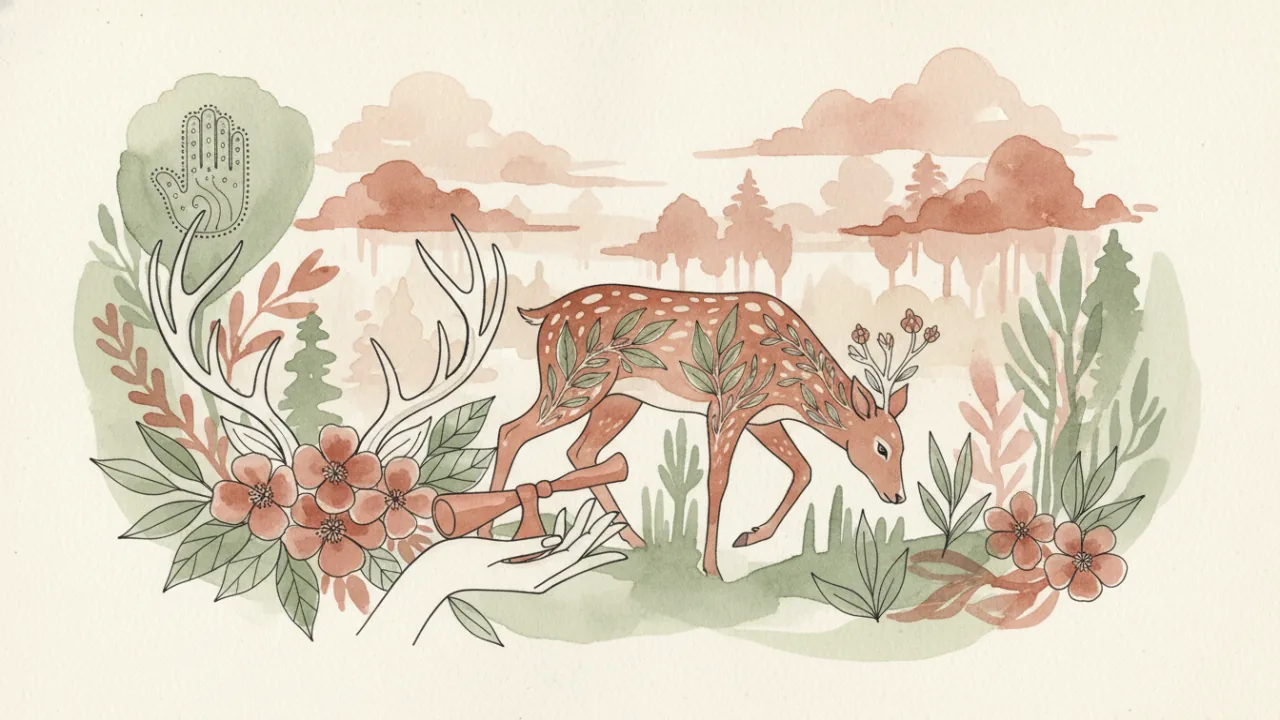
Watercolor scene evoking the energy of the Maya day sign Manik'

Cosmology and origins

Manik' is the seventh nawal of the tzolkin, and in the older highland communities its glyph reads as a hand frozen in mid-grasp — fingers curled toward the palm in the gesture a healer uses to test for warmth, a hunter uses to nock an arrow, a weaver uses to pinch a thread. The day-keepers of the K'iche' and Kaqchikel still call this sign by the deer (kej, kiej) as often as by the hand. The two readings sit on top of each other: the deer's hoof and the human palm, both tools for moving carefully through difficult terrain.

In Classic-period inscriptions Manik' often appears in the company of forest deities and household ritual scenes — never in the dramatic warrior-poses reserved for K'awiil or the lords of the night. The associations are domestic in the deepest sense: the household that knows how to treat injury, the family that knows where the springs are, the lineage that hands down the right way to cut, sew, dress, and dry whatever the forest has given. Manik' is the count's record of competence as a sacred quality.

Cardinally, Manik' belongs to the west — the direction of dusk, of the deer leaving the milpa, of the day's work being closed up before night. That orientation is part of why the energy is so often described as steady rather than radiant. Sunset light is enough to finish what was started; you do not need full noon to see the seam.

As a birth-sign

Born under Manik', a person tends to arrive in a body that already has opinions. There is often an early, almost suspicious, ease with hand-tools and animals — the toddler who picks up the scissors the right way, the eight-year-old whose dog is unaccountably calm, the teenager who can splint a sprain without being taught. The intelligence is genuinely embodied: it lives in the wrists and shoulders before it lives in the explanation.

Socially, Manik' people are often quieter than the room expects. They listen with their whole bodies — they will notice the cousin who sat down too carefully, the friend whose breathing changed when a name was said — and they tend to respond by doing rather than by narrating. They will hand you the cup of water before they ask whether you are upset. This can read as undemonstrative; it is in fact a particular dialect of care.

The deer half of the sign gives a quality that the hand does not, by itself, explain: a willingness to step into terrain that is unfamiliar without making a production of the courage involved. Manik' people change cities, leave jobs, end relationships, and start over with less drama than their friends predict. The hoof knows that the path is made by walking, and the palm knows that the work, wherever it is, will be findable by feel.

Day-energy in practice

On a day governed by Manik', the count tilts toward whatever is in front of you that has been waiting for hands. The shelf you have been meaning to mount, the bicycle whose chain has been complaining for weeks, the loaf of bread that has been theoretical since Sunday — these are the day's natural offerings. The energy is not allergic to thinking, but it is allergic to thinking instead of doing. A Manik' day rewards the smallest concrete step over the most elegant plan.

Practitioners describe the day as having an unusual quality of lateral focus: a Manik' afternoon is good for the kind of work where the body holds the pace and the mind is allowed to wander productively in parallel. Long walks, repetitive cooking, weeding a row, sanding a board — these are all environments in which the day will hand you the answer to a question you weren't asking. Decisions made this way tend to be more durable than the ones made by sitting still and frowning.

What the day handles less well is performance and abstraction. Big presentations, status meetings, declarations of intent — these are out of phase with the nawal. If you can move the abstract task into a tangible one (write the letter by hand, draft the slides while standing, talk through the strategy on a walk), Manik' will help. If you insist on the boardroom version, the day will simply feel slow.

Practices and tradecraft

Day-keepers light a candle for Manik' in the language of useful work. The traditional offerings are practical things — a measure of corn, a coil of cord, a sharpened blade laid flat on the cloth — paired with the gentler ones: copal smoke, a sprig of pine, a bowl of clean water. The prayer is not for inspiration but for steadiness in the hands and clarity in the route. Households often pick a Manik' day to sharpen knives, condition tools, or restock the small medicines.

A simple personal practice for the day: choose one thing in your home that has been almost-broken for longer than you'd like to admit, and bring it the rest of the way to repaired. While you work, keep your phone in another room. Manik' is patient with the actual fix and impatient with the consultation about the fix. If the object is beyond repair, the same energy can be spent retiring it cleanly — donated, composted, dismantled for parts — rather than letting it linger as guilt.

Walking practice is also classically Manik'. A mid-length walk — forty minutes is a good unit — taken without headphones, on terrain that is varied enough to ask something of the feet, will often unknot a question that staring at it could not. The deer half of the nawal asks you to trust the stride. The hand half asks you to come back with something to show for the time, even if it is only a clearer head.

Tradeoffs and shadow side

The shadow of Manik' is the over-functioning hand: the person who reaches for the broken thing in someone else's life before being asked, who fixes the symptom because the symptom is fixable, who picks up labor that wasn't theirs to carry because watching it sit undone is unbearable. This is competence turned into a wall. The Manik' shadow does not feel like a vice from inside — it feels like being responsible — but it can quietly hollow a person out, and it can deprive the people around them of the dignity of doing their own work.

A second tradeoff is silence around emotion. Manik' is fluent in action and sometimes monolingual: when something hurts, the impulse is to fix or to fetch rather than to sit and feel. Partners and close friends of strong Manik' people often have to ask, gently and explicitly, for the conversation that has no task attached. The nawal can learn this dialect, but it does not come pre-installed.

A third is the deer's flight reflex. When the terrain becomes politically or emotionally complicated in a way that hands cannot resolve, Manik' is tempted to leave — quietly, competently, without slamming any doors. This is sometimes the right answer and sometimes a way of declining a conversation that the person was actually ready for. The work is learning to stand still in places that do not, at first, look like work.

Trecena rhythms

A trecena that opens with 1 Manik' is, in the day-keepers' shorthand, a stewarding cycle. The thirteen-day stretch favors maintenance and craft over launch and conquest: it is the right window for tending the garden you already planted, mending the relationships you already have, rebuilding the inventory of skills your year has been quietly drawing down. People who track the count often use these trecenas to take on apprentice-shaped work — either as the apprentice or as the one teaching with their hands.

Inside the trecena, the middle days (around 6 Manik' through 9 Manik') tend to be the most physical. Day 6 in this count carries a flow energy and pairs especially well with Manik's hand-work; day 9 brings a steadying weight, the kind that asks you to commit to the project past the novelty. If you started something on day 1 and lost the thread by day 5, days 6 through 9 are when the deer's stride lets you pick the trail back up without ceremony.

The closing days, especially 12 Manik' and 13 Manik', have a quality of finishing rather than concluding — putting the tools away, oiling them, hanging them in the order in which they will be wanted next time. A trecena opened by Manik' rarely ends with a flourish. It ends with a workshop that is ready for the next morning, and that is exactly what the nawal asks of it.

Frequently asked questions

  • What does Manik' mean in the Maya calendar?

    Manik' is the seventh of twenty tzolkin day signs. The Yucatec name reads as hand; the K'iche' Kej reads as deer. Both refer to one nawal of grounded action, craft, healing, and balance across the four cardinal directions.

  • What direction and color rule Manik'?

    Manik' belongs to the West and the color blue — the dusk family of receptive, transformative signs (alongside Ak'b'al, Chuwen, Men, and Kawak). West light is the energy of finishing the day's work before nightfall.

  • Why is the Manik' glyph a hand if the day is also called Deer?

    The hieroglyph shows a hand making a precise grasping gesture — the same pinch a healer, hunter, or weaver uses. Other Mesoamerican scripts paint a deer head for this day. Maya scribes chose the hand because Kej's gift is competence.

  • What does "four directions" mean for someone born on Manik'?

    In K'iche' kej also means four. The deer plants one leg in each cardinal point, so Manik' people are read as natural balancers — guardians who hold vitality, wisdom, spirit, and healing together in the body before they explain it in words.