Day 16 of 20 in the tzolkin

K'ib'

wax / candle

The candle keeps its own time.

  • patience
  • illumination
  • reckoning
  • ancestral

K'ib' is the candle — wax, wick, and the particular quality of light a flame gives in a quiet room. The nawal is about patient illumination: not the searchlight, the prayer-candle. It's also the sign of the ancestors, of the long memory the candle stands in for.

People born under K'ib' tend to do good work with what other people would rather not look at. They are forgiving without being naive. They have an instinct for repair — of relationships, of histories, of inherited patterns — and they're willing to take the long route to get there.

On a K'ib' day, light something. Burn the letter. Light the candle for the person you're trying to forgive, including yourself. The nawal honors the small ritual that won't show up in any productivity log but resets the room.

A trecena opened by K'ib' is reckoning, in the gentle sense — clearing accounts, making peace, paying respects.
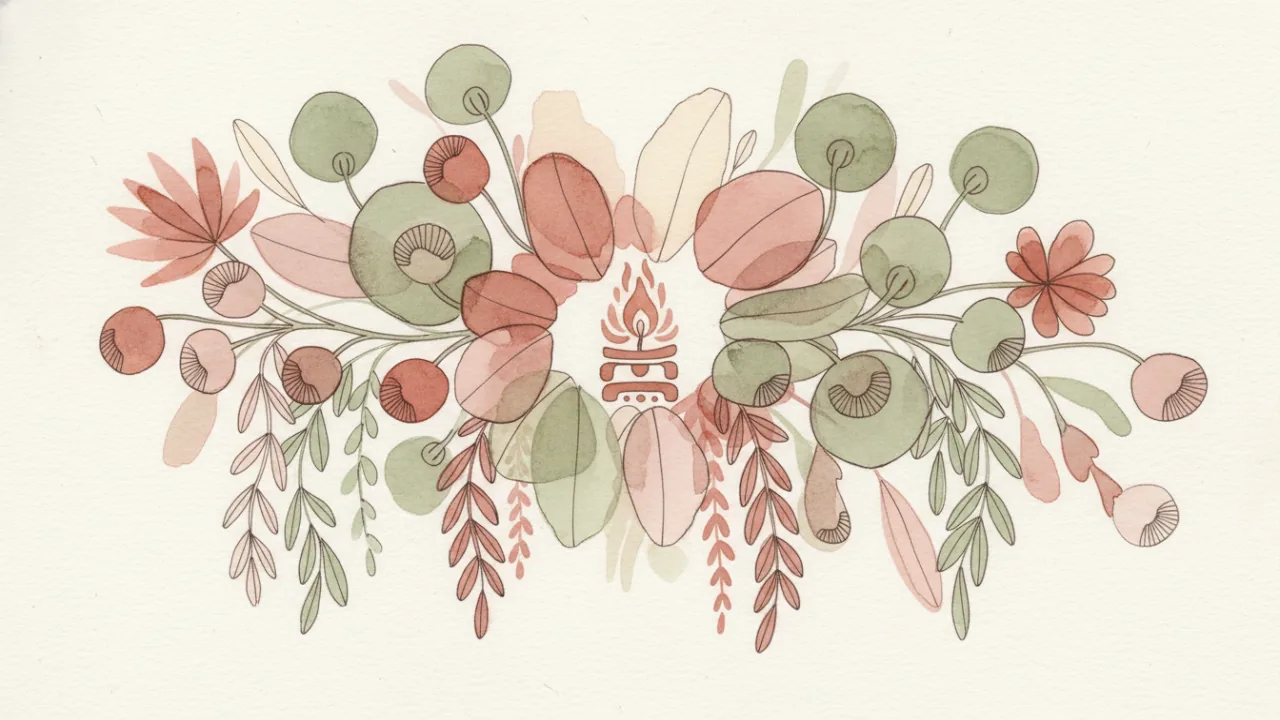
Watercolor scene evoking the energy of the Maya day sign K'ib'

Cosmology and origins

K'ib' lives in the older Maya stratum where light and memory are treated as the same substance. Long before the candle of beeswax sat in a parish chapel, the daykeepers were already lighting copal and pine resin in highland shrines, and the small steady flame was understood as a meeting place — between the household and the ancestors, between the visible day and the long count of the dead. The glyph is often read as wax-and-wick, but the deeper image is the flame that does not roar.

In the colonial centuries the candle absorbed Catholic vocabulary without losing its older grammar. Highland K'iche' and Kaqchikel daykeepers carried K'ib' into the cofradía and back out again, and to this day the nawal is honored at altars where saints, mountains, and the four winds share a single tablecloth. The patience the candle teaches is the patience of a tradition that has had to outlast several attempts to extinguish it.

What K'ib' carries forward, then, is not nostalgia but continuity. The flame that is small enough to cup in the hands is the same one that has been kept alight, in one room or another, for as long as anyone can remember. To work with this nawal is to take a turn at tending it.

As a birth-sign

People born on a K'ib' day tend to arrive in the world already on speaking terms with what came before them. Family stories settle in their bones early. They notice the unspoken inheritance — the grandmother's silence, the uncle's pattern, the apology nobody got around to making — and they tend, often without being asked, to become the one who does something quiet about it.

There is a particular K'ib' steadiness that is easy to miss because it does not perform. These are not the loudest people in a room; they are the ones the room reorganizes around when something has to be repaired. Friends find themselves telling K'ib' people things they have not told anyone, because the candle does not flinch and does not gossip. The light is patient enough for the truth to arrive in its own time.

The shadow of the gift is real: K'ib' carriers can absorb more than is theirs to carry, and sometimes confuse keeping the flame with keeping the ache. The work of a K'ib' life is learning to be a candle, not a furnace — to illuminate without burning oneself down to the wick.

Day-energy in practice

A K'ib' day in the count has a low, steady tone. It is not a day for bright launches or large rooms; it is a day for the kitchen table, the threshold of the bedroom door, the small altar in the corner. Things that have been waiting for the right light tend to find it now — letters that were never sent, names that were never said, accounts that were left half-closed.

Practitioners often describe K'ib' as the day the room finally settles. Pressure that has been crackling along a relationship eases enough for the real conversation to start. A grief that has been stuck in the throat softens enough to be spoken. The energy does not force anything; it makes the space honest enough that what needed to come forward can.

On a K'ib' day the most accurate question to ask is not what to achieve but what to acknowledge. The nawal tends to reward a small, deliberate act — lighting a candle for someone you have lost, calling the relative you have been avoiding, sitting for ten minutes with the photograph you keep face-down in the drawer.

Practices and tradecraft

Daykeepers' tradecraft for K'ib' centers on the altar and the small flame. A clean cloth, a candle that you light with intention, a glass of water, and the names — written or spoken — of the people you are remembering. It does not need to be elaborate. The discipline is the steadiness, not the staging: lighting it, sitting with it, letting it burn down without checking your phone.

Repair work is the other K'ib' specialty. Practitioners use the day for the patient correspondence of the heart: writing the apology that has been overdue, drafting the letter you may or may not send, setting down on paper a forgiveness you have been waiting to feel ready to offer. The act of writing it counts even when the letter does not leave the desk; the candle has witnessed, and that is part of the rite.

K'ib' also asks that the keeper tend their own light. Daykeepers warn against pouring out illumination for everyone else and going dark at home. A simple closing practice — a hand over the heart, a thank-you to the flame, a deliberate extinguishing rather than a blown-out one — keeps the wick clean for the next day's work.

Tradeoffs and shadow side

The shadow of K'ib' is the candle that cannot let itself go out. People with this nawal sometimes mistake endurance for love and find themselves keeping vigils nobody asked for — over relationships that have already ended, over family stories that need to be set down, over guilt that has long since paid its bill. The flame becomes a duty rather than a presence.

There is also a quieter shadow: the K'ib' habit of carrying everyone else's unfinished business. The nawal's gift for sitting with what others won't can curdle into the belief that one is the only person willing to look. From there it is a short step to resentment, exhaustion, and the particular loneliness of the household saint.

The corrective is not to put the candle down — that is not what K'ib' is for — but to learn the difference between keeping the flame and being the fuel. Honest accounts include the keeper. Repair includes the one repairing. The candle is most truthful when it is allowed, sometimes, to rest on its plate and be still.

Trecena rhythms

A trecena that opens with K'ib' sets a thirteen-day arc of gentle reckoning. The first days tend to bring up what has been waiting in the back of the drawer — old correspondence, old debts, old conversations one had been hoping to outlast. The energy is not punitive. It is the candle finally giving enough light for an honest look.

Mid-trecena the work usually moves from naming to repairing. By days six and seven, K'ib' carriers and people working consciously with the count often find themselves doing the small, unglamorous tasks that thread a torn relationship back together: the phone call, the visit, the line item finally paid. Nothing here is dramatic; the trecena does not photograph well.

The closing days are for gratitude and release. A K'ib' trecena tends to end not with a flourish but with a clean altar — accounts squared, words said, a candle burned down in good order. What you started under K'ib' will not always be finished by the next trecena, but it will be honest, and the light will keep its own time.

Frequently asked questions

  • What does K'ib' mean in Maya?

    In Yucatec Maya, K'ib' literally means wax — beeswax — and stands for the candle and its small steady flame. In K'iche' the same day is called Ajmaq, forgiveness or sin, pointing to the ancestral reckoning the candle is lit for.

  • What is the Ajmaq nawal?

    Ajmaq is the K'iche' name for the 16th Maya day sign. It is the nawal of forgiveness, ancestors, and honest accounting. Day-keepers use Ajmaq days to ask grace from grandparents, release resentments, and repair inherited patterns.

  • Why is K'ib' linked to both a candle and a vulture?

    Both images describe purification. The Yucatec candle gives patient light to look at what was hidden; the vulture, in older Maya readings, carries off what is dead so something new can grow. One nawal, two metaphors for cleansing.

  • What direction and color does K'ib' belong to?

    K'ib' belongs to the South and the color yellow — the ripening, harvesting quadrant of the tzolkin, shared with K'an, Lamat, Eb', and Ajaw. The South energy explains why K'ib' work feels like harvest of what was sown long ago.