Day 1 of 20 in the tzolkin

Imix

primordial waters / waterlily

The unformed beginning. Everything before structure.

  • origins
  • instinct
  • fertile chaos
  • tender beginnings

Imix opens the tzolkin because nothing comes before it. The waterlily floats on the dark surface of the world before names exist — that is the energy: prelinguistic, oceanic, charged with possibility but not yet shaped. People who carry Imix tend to feel things before they can articulate them, and they often start projects from a hunch rather than a plan.

As a birth-energy, Imix gives a deep, almost amphibian sensitivity. There can be a lot of caretaking impulse here — the maternal current is strong — and a tendency to absorb the moods of a room. The work of an Imix nawal is learning when that porousness is a gift and when it is a leak.

On a day governed by Imix, beginnings feel softer than they look. It's a good day to listen to dreams, to the body, to half-formed ideas you've been embarrassed to say out loud. It is not a good day to demand finished answers from yourself.

The trecena that opens with Imix is one of incubation. Things are still being made of water — give them time to find their banks.
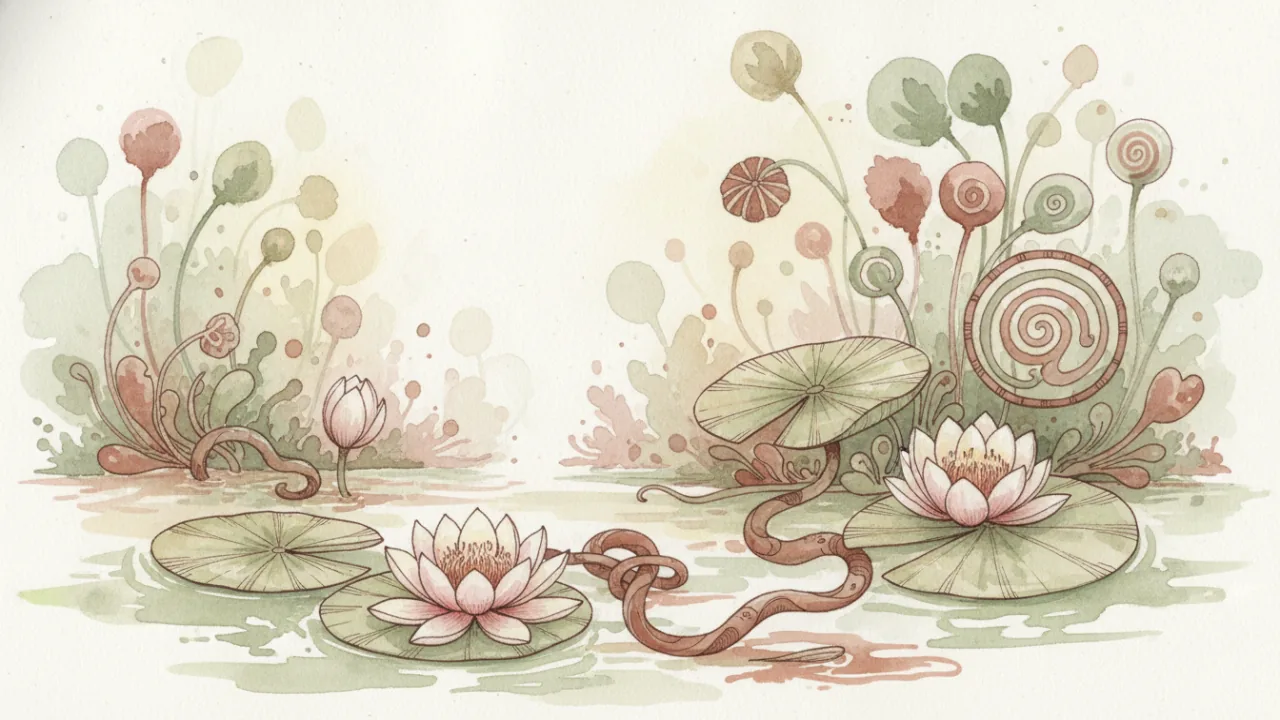
Watercolor scene evoking the energy of the Maya day sign Imix

Cosmology & origins

Imix sits at position one in the tzolkin — the first of the twenty day-signs that, paired with thirteen numbers, weave the 260-day count the Maya have kept for at least two and a half thousand years. That placement is doctrinal, not decorative. Before there is wind to be named, before there is a road to be walked, before there is a jaguar in the canopy or a sun overhead, there is water. Imix is the count agreeing on its own starting point: the unstructured medium out of which the rest of the calendar will be drawn.

The older Maya sources give Imix a tangle of overlapping images — the waterlily floating on a black surface, the crocodile whose back is the world, the maternal womb-water of a being not yet born. The colonial dictionaries flatten this into a single gloss, but for working ajq'ij the multiplicity is the point. What Imix names is not one object but the condition that allows objects: the dark, the wet, the formless that is also fertile. The same water that drowns is the water the seed needs.

The glyph itself carries this. Most reconstructions show a stylized waterlily pad, sometimes paired with the cross-hatching that elsewhere in Maya art denotes things hidden, interior, underwater. It is the day-sign that says: here, before language. When a ceremony opens with Imix it opens at the cenote, not at the temple steps — at the place where the world remembers it was once water before it agreed to be ground.

As a birth-sign

Being born under Imix tends to feel, from the inside, like having one extra sense organ that the people around you don't quite have. Mood, atmosphere, what someone is not saying — these arrive as physical information before they arrive as thought. Many Imix people describe a childhood of being told they were too sensitive, and a slow adult realization that the sensitivity was correct and the room was simply not telling the truth.

The strands that run through Imix lives are recognizable. A pull toward caretaking that can become reflexive. A creative practice that feeds on dream-residue more than on planning. A tendency to start things on intuition and then quietly engineer the form afterwards. Imix people often work in caring or making professions — therapy, midwifery, art, cooking, teaching small children — fields where the porousness is a working tool rather than a liability.

What this nawal makes easier is contact. Imix people are unusually good at meeting another person where that person actually is, rather than where it would be convenient for them to be. What it makes harder is the boundary between self and surround. The lifelong learning is when to be a sponge and when to be a banked river: still wet, still alive, but with sides.

Day-energy in practice

When Imix lands on the calendar the day tends to feel slightly underwater. Edges blur. Plans that looked rigorous yesterday now want a softer treatment. People often report unusual dreams the night before an Imix day, and a kind of emotional weather that arrives without an obvious cause — a wash of tenderness, or grief, or longing for something they can't quite name. None of this is malfunction. It is the nawal doing what it does: returning the practitioner to the prelinguistic register that the rest of the count rests on.

Imix days pattern with beginnings that aren't quite ready to be announced yet. The hunch you've been having about a project, the half-shape of a song, the conversation you keep almost having with someone — these surface on Imix days because the surface itself is more permeable. Treat what surfaces as data, not as homework. The day rewards noticing; it punishes premature commitment.

Within a single day the Imix energy tends to peak in the early hours and again at dusk, the two windows when the boundary between dreaming and waking is structurally thinner. Many ajq'ij schedule Imix work for those hours intentionally: candle lit before sunrise, water set out, journal open, the rest of the world not yet making noise.

Practices & tradecraft

Imix is the day to do anything that benefits from being met halfway by the unconscious. Dream journaling is the obvious one — write down what came in the night before any rationalization sets in, in fragments, without trying to interpret. Freewriting also works well: a timer, a blank page, no editor. So does walking near actual water. The nawal is literal that way; a cenote, a river, a bathtub, even a sink full of warm water all give the energy a body to come through.

Decisions made under Imix are best treated as the first reading of an instrument, not the verdict. If something feels true on an Imix day, write it down and let it sit until a Manik' or Ben day, when the energy is structurally readier to commit. Conversely, a thing that no longer feels right under Imix usually really doesn't — the nawal strips off the social pretexts that propped it up and shows you what's underneath.

For collaborative work the energy lends itself to early-stage brainstorming, premise conversations, and any meeting where the goal is to find out what the actual question is. It does not lend itself to executive review, contract signing, or anything else that needs a finished surface. A useful framing: Imix opens the file. Other nawals close it.

Tradeoffs & shadow side

The shadow of Imix is the gift run too long without banks. The same porousness that lets an Imix person feel a grieving room before anyone speaks can flood them when they don't have a way to discharge what they've absorbed. Untended, this shows up as exhaustion, low-grade depression, somatic illness, and a sense of being permanently behind on rest. The nawal isn't punishing anyone; it's simply not meant to be left running with no return circuit.

There is also the shadow of the unstarted. Imix is the energy before form, and people who carry too much of it without finding a counterweight can become permanent rehearsers — endlessly preparing, endlessly almost-beginning, never crossing the line into commitment. The waters are fertile, but a crop has to be planted somewhere or it stays in the imagination. Healthy Imix work pairs the unstructured with a structuring partner — a deadline, a collaborator, a Ben or Manik' day on the calendar.

What an Imix-born person should watch for is the slow drift into other people's emotional weather as a substitute for their own life. The instinct to absorb is real, but absorbing is not the same as serving. A useful gut-check: after this exchange, do I know more about myself, or only about the other person's mood? If only the second, the porousness is leaking, not gifting.

Trecena rhythms

When Imix opens a trecena — the thirteen-day arc that begins with 1 Imix and ends with 13 Ix — the whole stretch tends to feel incubatory. Things start, but in the way a pregnancy starts: invisibly, internally, with a quiet that can be mistaken for nothing happening. Practitioners who are used to other trecenas, especially the more declarative ones, sometimes spend the first three or four days of an Imix trecena waiting for it to begin, only to realize on day five that it began on day one and they were simply expecting the wrong shape.

The pressure inside the cycle tends to build through the middle days, around 6 Kimi and 7 Manik', when the soft-water beginning meets its first real structural questions. This is often where decisions about a still-forming project become unavoidable, and where the trecena either deepens or stalls. It releases later, in the high single digits and low teens, when whatever has actually rooted starts to show its first visible shape.

Across a 260-day count there are twenty trecenas, and the Imix trecena is the one most reliably described as tender. Many ajq'ij plan accordingly — heavier on dream-work, ceremony, and rest, lighter on launches and public-facing commitments. Whatever is allowed to incubate fully here tends to come into the next Ik' trecena with real wind in its sails. Whatever is forced into form too early in this stretch tends not to last.

Frequently asked questions

  • What does Imix mean in the Maya calendar?

    Imix is the first day-sign of the 260-day Maya tzolk'in. It means crocodile or water lily and points to the primordial waters from which the world rises. K'iche' Maya call it Imox; the energy is origin, intuition, and the unformed beginning.

  • What are Imix people like?

    Imix-born people are intuitive, dream-attuned, and emotionally porous — they often sense a room before anyone speaks. They lean toward caretaking and creative work and do well in art, therapy, midwifery, and teaching.

  • Is Imix a good day to start things?

    Yes for soft, intuitive beginnings — dreamwork, journaling, premise conversations, listening to half-formed ideas. Not for executive decisions or contract signing. Imix opens the file; later nawales like Manik' or B'en close it.

  • What direction and color belong to Imix?

    Imix sits in the East and carries the color red — the direction of sunrise, life force, and initiation. Its element is primordial water, and its patron force is the cosmic Water Serpent / crocodile whose back the world rests on.