Day 6 of 20 in the tzolkin

Kimi

transition / death

The doorway. Both sides of it sacred.

  • release
  • transition
  • composting
  • respect

Kimi is often translated as death, but the older sense is closer to transition: the doorway, the threshold, the moment of letting one shape go so the next has room. The Maya don't moralize this — endings are part of how the calendar breathes.

People born under Kimi tend to be unusually unflinching about endings. They are the friends who can sit with a grieving room without flinching, who know how to close a chapter cleanly, who don't romanticize what's already gone. They sometimes feel older than they are.

On a Kimi day, finish things. Send the goodbye email. Throw out the half-thing you've been pretending you'd return to. Pay a debt. The nawal favors clarity, not sentimentality.

A trecena opened by Kimi is for shedding — clearing the field so something honest can be planted. The new growth comes later; this stretch is for the work of letting go.
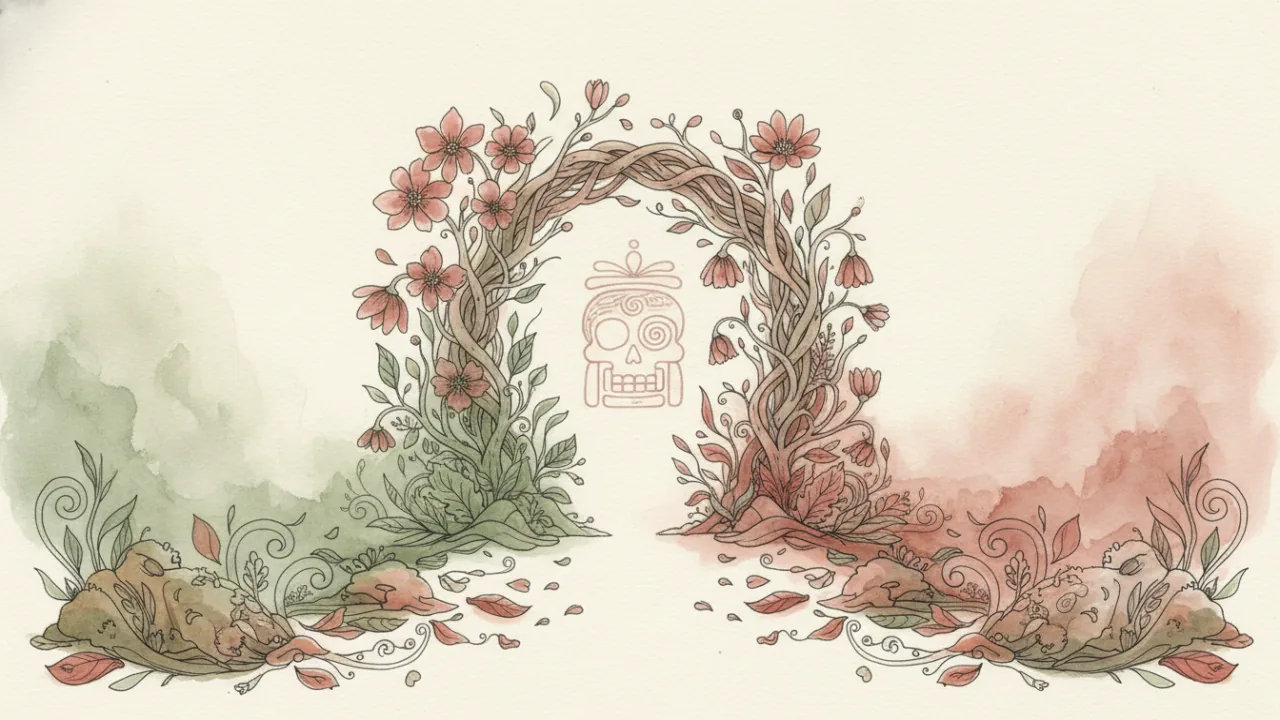
Watercolor scene evoking the energy of the Maya day sign Kimi

Cosmology and origins

Kimi sits sixth in the count of twenty nawales, and the older Yucatec and K'iche' communities have always been careful with how they speak of it. The colonial dictionaries flattened the word into the Spanish muerte, but the daykeepers who still walk the count in highland Guatemala will tell you the glyph is closer to a doorway than to a grave — a hinge between forms, not a verdict on a life.

In the Popol Vuh and in the surviving codices, the underworld of Xibalba is not a punishment. It is a workshop where the maize hero is taken apart, ground, and remade. Kimi inherits that worldview wholesale: dissolution is part of how cosmic material gets reused. The bones of the old hero become the seed of the new corn, and the calendar keeps walking.

Some communities still light a candle on Kimi days for ancestors and for closures that haven't yet been honored. The gesture is quiet and practical — incense, a name spoken aloud, a small offering — because the tradition treats the threshold as a place that responds best to dignity rather than drama.

As a birth-sign

Children born on a Kimi day are often noticed early for a kind of composure their peers don't have. They can be in a room where something painful is happening without performing rescue and without fleeing. Elders sometimes describe these children as having arrived already knowing how rooms close.

As adults, Kimi-born people tend to land in roles the rest of us avoid: hospice work, end-of-life conversations, mediating estates, untangling the messy last chapter of a project everyone else has stopped attending to. They aren't drawn there because they enjoy endings — they're drawn there because they can stay present where presence is most needed.

The lifelong work of a Kimi nawal is making sure the unflinching gaze doesn't become detachment. The same steadiness that helps you sit with a dying friend can, untended, become a habit of disappearing emotionally before goodbye is actually called for. Naming the difference is part of growing into the sign.

Day-energy in practice

On a Kimi day the field around decisions clarifies. Things that have been kept alive on courtesy or inertia start showing their seams, and the courteous lie costs more energy than usual to maintain. People notice that their attention drifts toward the unfinished — the unsent letter, the email that has been in drafts for three weeks, the conversation everyone has been pretending not to need.

The traditional advice is to meet that drift directly rather than swerve around it. Pay the small debt. Return the borrowed book. Send the message acknowledging the friendship has changed. The day rewards the gesture that honors what was without pretending it's still current.

It is also a good day to tend to grief that has been waiting. Kimi gives a kind of permission slip: you don't have to be finished mourning by sundown, you only have to let the feeling have its full size for the duration of the day.

Practices and tradecraft

Daykeepers working a Kimi day often begin by lighting one candle for what is leaving and one for what is making room — two flames on the same altar, no bargain between them. The pairing reminds the practitioner that release and welcome are continuous, not opposed.

Useful practices in this energy are tactile and small. Sort one drawer. Compost the dead plant rather than guilt-watering it for another week. Write a letter to someone who is gone and burn it. Walk a familiar route in reverse. The physical gesture lets the body register the closure the mind has been refusing.

If you keep a journal, Kimi favors a particular prompt: what am I carrying that is no longer mine to carry? Write the answer plainly, without making it a performance of insight. Then notice which of those things can actually be set down today, even partially, even just for the duration of an afternoon.

Tradeoffs and shadow side

The shadow of Kimi is premature ending — closing doors that the situation never asked you to close. The same nawal that helps you finish honestly can, if it goes unchecked, start treating every difficulty as proof that something must die. Relationships, projects, and chapters all have rough patches that look like death and aren't.

Another tradeoff is emotional armoring. Sitting with so many endings teaches a person to brace, and bracing held too long becomes a wall. Kimi-born people sometimes find themselves explaining their lives in the past tense, treating the present like an artifact already on its way to a museum.

The traditional correction isn't to feel less; it is to remember that the threshold has two sides. Kimi is not the energy of being already gone, it is the energy of the doorway. The doorway is also the thing through which someone walks in.

Trecena rhythms

A trecena that opens with Kimi sets a particular tone for its thirteen days. The first stretch tends to be quiet, sometimes uncomfortably so. The work being asked is subtraction rather than addition: clearing what has gone unsorted, returning what was borrowed, naming what is finished.

Around the middle of the count, the field begins to feel more spacious. Things you didn't realize were taking up room have moved out, and there is a curious lightness that older daykeepers describe as the smell of swept ground after a storm. This is when the next planting becomes thinkable, though not yet urgent.

By the closing days the trecena turns its attention forward. Whatever you allowed to end honestly has made room for a new shape, and the energy that was tied up in maintaining the old one is back in your hands. The Maya teach this rhythm without sentimentality: shedding first, room second, growth third, in that order.

Frequently asked questions

  • Is Kimi a bad sign?

    No. Kimi (Kame) is often mistranslated as death, but Maya day-keepers treat it as a threshold of transformation. Kame days are traditionally used to pray for long life, healing, and protection of travelers — not feared.

  • What does Kimi mean in the Maya calendar?

    Kimi is the 6th of 20 tzolkin day signs (K'iche': Kame; English: Death/Transition). It governs endings, release, and ancestor connection. Direction North, color white. Its glyph is a closed-eye skull.

  • What are Kimi people like?

    Kimi-born tend to be calm, intuitive, and unflinching with endings. They gravitate to hospice work, end-of-life care, mediation, and ancestral ritual. Shadow side: emotional armoring and ending things prematurely.

  • What should I do on a Kimi day?

    Finish what is open. Pay a small debt, return a borrowed item, send the goodbye message, tend a waiting grief. Light a candle for an ancestor. Maya tradition uses Kame days for healing and protecting travelers.