Day 19 of 20 in the tzolkin

Kawak

storm / rain

The clouds gather, the clouds break, the field is washed.

  • renewal
  • release
  • intensity
  • regeneration

Kawak is the storm — and the Maya storm is not a problem, it's a renewal. The pressure builds, the sky opens, the rain washes the field, and afterwards the air is different. The nawal honors that whole arc: the gathering, the break, and the freshness that follows.

People born under Kawak often run hot. They feel things at high amplitude and often have a precipitation cycle to their lives — long buildups, dramatic releases, periods of quiet renewal. They tend to be passionate, sometimes intense, and unusually generous after the storm has passed.

On a Kawak day, the pressure that's been building is closer to releasing than you think. Cry if you need to. Have the conversation you've been postponing. The nawal does not reward bottling; it rewards the courage to let the storm be a storm so the next thing can grow.

A trecena opened by Kawak is regenerative. Expect upheaval and new shoots, often in the same week.
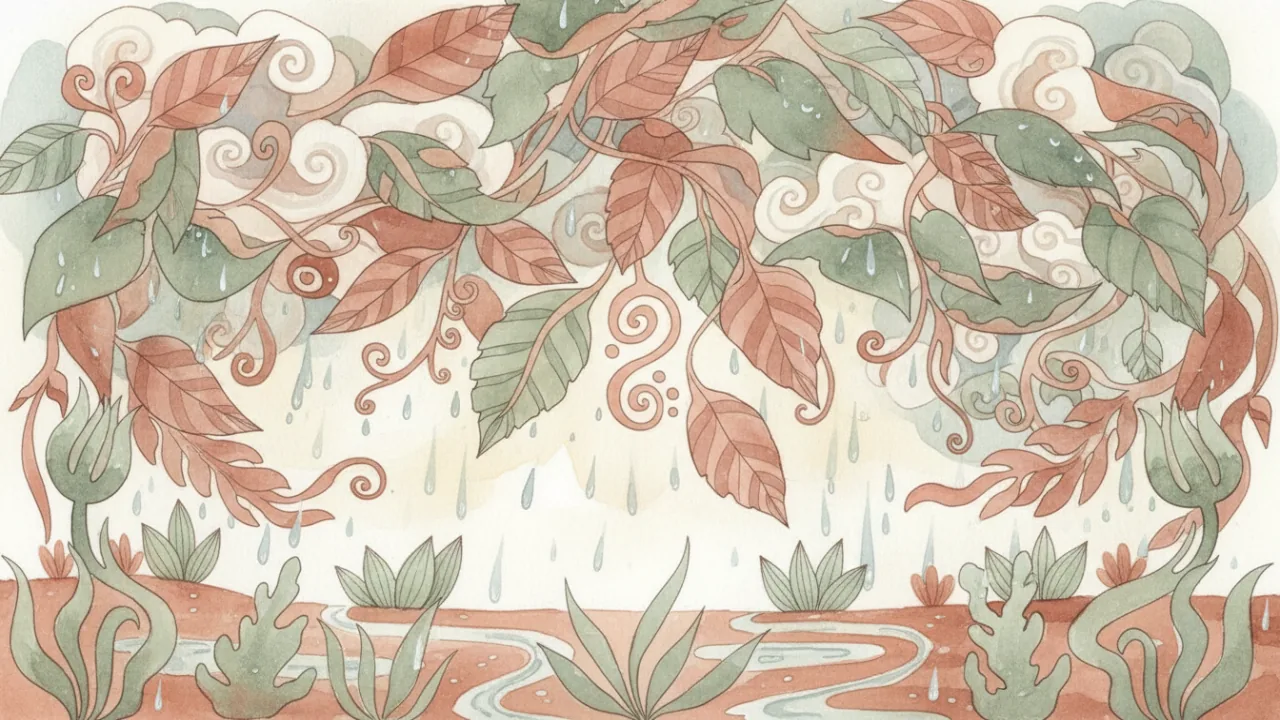
Watercolor scene evoking the energy of the Maya day sign Kawak

Cosmology and origins

Kawak is the storm-glyph of the tzolkin, and the older Maya pictured it as a bundle of weather: the bruised sky before rain, the first rolling thunder, the fat drops that turn dust to mud, and the green smell that rises from the field afterwards. In the codices the day-sign is often drawn with rain-curls and a vessel pouring out — water held until it must be released. The same root word travels through K'iche', Yukatek, and Tz'utujil with small shifts of accent: the storm is shared territory across the highland and lowland traditions.

The community that lived under volcanic peaks and seasonal rains did not treat the storm as an interruption. Storm clouds gathered in the milpa cycle the way they gathered in the calendar: predictable, fierce, and necessary. Without Kawak, the corn does not break the soil. Without Kawak, the springs run thin. The day-keepers placed the storm late in the cycle — close to Ajaw — because pressure that has been built across a whole trecena has to find its release somewhere, and the calendar is honest about saying so.

What survives in living practice is a careful respect, not a fear. Kawak is treated as an ally that arrives loud. Offerings on a Kawak day often involve water — pouring, scattering, washing — and the language used by aj q'ijab' working with this nawal tends toward verbs of opening rather than verbs of avoidance. The storm is allowed to do its work.

As a birth-sign

Kawak as a birth-energy gives a person a high-amplitude inner weather. Feeling does not arrive on a flat line; it builds, breaks, and clears. People with this nawal often describe their lives as a series of long buildups followed by sudden releases — a relationship that ran fine for two years and then turned over in a weekend, a job that quietly clouded for months and then ended in a single conversation. The shape is not chaos. It is a precipitation cycle.

From the outside, Kawak people are often read as intense. From the inside, the intensity is rarely the point — what they are tracking is pressure, theirs and the room's. Many of them are unusually tuned to atmospheric shift: they know when a friendship is going to need a hard talk, when a project is about to crack, when a family is sitting on something. They can be loyal in a way that surprises people who only saw the loud weather, because they tend to keep showing up after the storm has cleared the air.

The lifelong work of the Kawak nawal is befriending its own arc. Bottled, the energy turns sour and turns inward. Honored, it produces some of the most regenerative people in any room — the ones who can take an old, exhausted situation and break it open so something living can grow.

Day-energy in practice

On a Kawak day, the felt sense is of a sky that is heavier than it was yesterday. Conversations that have been politely deferred sit closer to the surface. The body often knows first — a tightness in the shoulders, a restlessness around bedtime, a temper that needs less than usual to flare. None of this is a problem. It is the calendar telling the truth about what has accumulated.

The day rewards letting the storm be a storm. If grief has been waiting, the tears land. If a hard thing needs to be said, the words come out cleaner than they would on a softer day. Even small releases count: a long walk, a real cry, an honest paragraph in a journal, a window thrown open in a stuffy room. What the nawal does not reward is the performance of calm over a sky that is plainly dark.

After the break, Kawak quiets quickly. The afternoon of a Kawak day, or the morning after, often carries a distinctive freshness — the post-rain hour. Plans made in that hour tend to be unusually clear. Many practitioners hold any decision they are unsure about until that wash has happened, because the air on the other side of a storm tells the truth in a way the pressure beforehand cannot.

Practices and tradecraft

Working with Kawak well begins with reading pressure honestly. The simplest practice is a daily pressure check: where in the body is something held, what conversation is being avoided, what room feels stuffy. Naming the pressure does not release it, but it locates it — and once located, it can be tended rather than dragged around as background weather.

Water is the natural medium of this nawal. A Kawak-flavored practice can be as plain as a long shower with the intention of letting something go down the drain, or as ritual as pouring water over the hands before a difficult conversation, or as physical as swimming until the body has nothing left to argue about. The point is the same: give the energy somewhere to discharge that doesn't damage the field. Many aj q'ijab' working with this day will burn copal at the start and pour water at the end — pressure rising in the smoke, freshness coming down in the rinse.

On the relational side, Kawak rewards the courage to host the storm rather than be ambushed by it. That can mean scheduling the hard conversation deliberately, with both people fed and rested, rather than letting it erupt in a tired hour. It can mean naming, out loud, that something has been building. The nawal is not asking for drama; it is asking for the dignity of a release that was chosen, not collapsed into.

Tradeoffs and shadow side

The shadow of Kawak is the storm that never lands — pressure held so long it goes inside, where it shows up as anxiety, insomnia, somatic tightness, and a temper that flashes at the wrong target. People with this nawal who never learned to release end up looking either eerily controlled or unpredictably explosive, sometimes both in the same week. The work is not to dampen the weather; it is to give it a sky.

There is a related shadow on the other side: the storm used as an instrument. A Kawak person who has discovered how powerful their release can be sometimes weaponizes it — picking fights to feel the discharge, breaking things off so they can feel the relief of the air clearing. The nawal does not endorse this. The point of the storm in the milpa is not the lightning, it is the green that comes after. A storm that leaves no growth is a storm that has been misused.

The third tradeoff is timing. Kawak energy honors release, but a release dropped on a person or a project that wasn't ready for it leaves wreckage rather than freshness. Mature practice with this nawal includes asking, before the break, whether the field is in any shape to receive what is coming. Sometimes the right move is to wait one more day, water the ground, and storm tomorrow.

Trecena rhythms

A trecena opened by Kawak runs hot from day one and clears late. The first three or four days tend to be turbulent — the buildup that has been dragging across previous trecenas finally has a calendar that gives it permission to break. People who know the count often plan lighter schedules across this opening, because anything that can be released will be, and trying to push fresh new initiatives into a wet field rarely lands well.

Mid-trecena, the rhythm shifts. By the seventh or eighth day, much of what needed to fall has fallen, and the energy turns toward what can be planted in cleared ground. This is when conversations that felt impossible at the start of the week get a second draft; relationships that looked finished sometimes find a quieter, truer version of themselves. The nawal is more interested in what comes after the rain than in the rain itself.

The closing days of a Kawak trecena have a distinctive freshness. The practitioner's task is not to relapse into old pressure out of habit. Note what survived the storm. Note what didn't. Plant accordingly. A trecena that began as upheaval can end as one of the most fertile stretches of the year, but only for those who refuse to rebuild exactly what the rain just washed away.

Frequently asked questions

  • What does the Maya day sign Kawak (Kawoq) mean?

    Kawak is the 19th day of the tzolkin — the storm. It signifies rain, lightning, cleansing release, and the renewal that follows. In K'iche' it is Kawoq and carries the meaning of family, community, and anything that gathers.

  • What is the direction and color of Kawak?

    Kawak belongs to the West and the color blue, the direction of transformation and receptive death-rebirth energy. It shares this quarter with Ak'b'al, Manik', Chuwen, and Men.

  • Why is Kawak linked to Chaak and to midwives?

    Chaak is the Maya rain god whose lightning splits the rock to release maize. Kawoq mirrors this release — clearing pressure so new life can emerge. K'iche' day-keepers therefore associate Kawoq with midwives and the sacred turbulence of birth.

  • Is Kawak a Year Bearer?

    Yes. In the Postclassic Yucatec calendar at Mayapan and at contact, the four Year Bearers were K'an, Muluk, Ix, and Kawak. A Kawak year carries storm-energy across the whole haab, themed around release and communal renewal.