Day 14 of 20 in the tzolkin

Ix

jaguar

The jaguar walks the canopy, and you don't hear it.

  • magic
  • secrecy
  • inward power
  • shamanic

Ix is the jaguar, and in Maya thought the jaguar is the shaman's animal: the one who crosses thresholds, walks at night, and carries a power that doesn't need to announce itself. The nawal is private, intelligent, and a little uncanny.

Born under Ix, people often have a relationship with their inner life that the people around them only glimpse. They tend to be drawn to anything liminal — dream, ritual, deep study, the parts of a discipline most practitioners don't reach. They often look ordinary on the outside while running something elaborate on the inside.

On an Ix day, the magical channel is open. The nawal favors quiet practices: meditation, ceremony, the slow careful re-reading of something you thought you understood. Loud, public actions are not what this energy is for.

A trecena opened by Ix is initiatory. Whatever you start in this stretch tends to deepen rather than broaden.
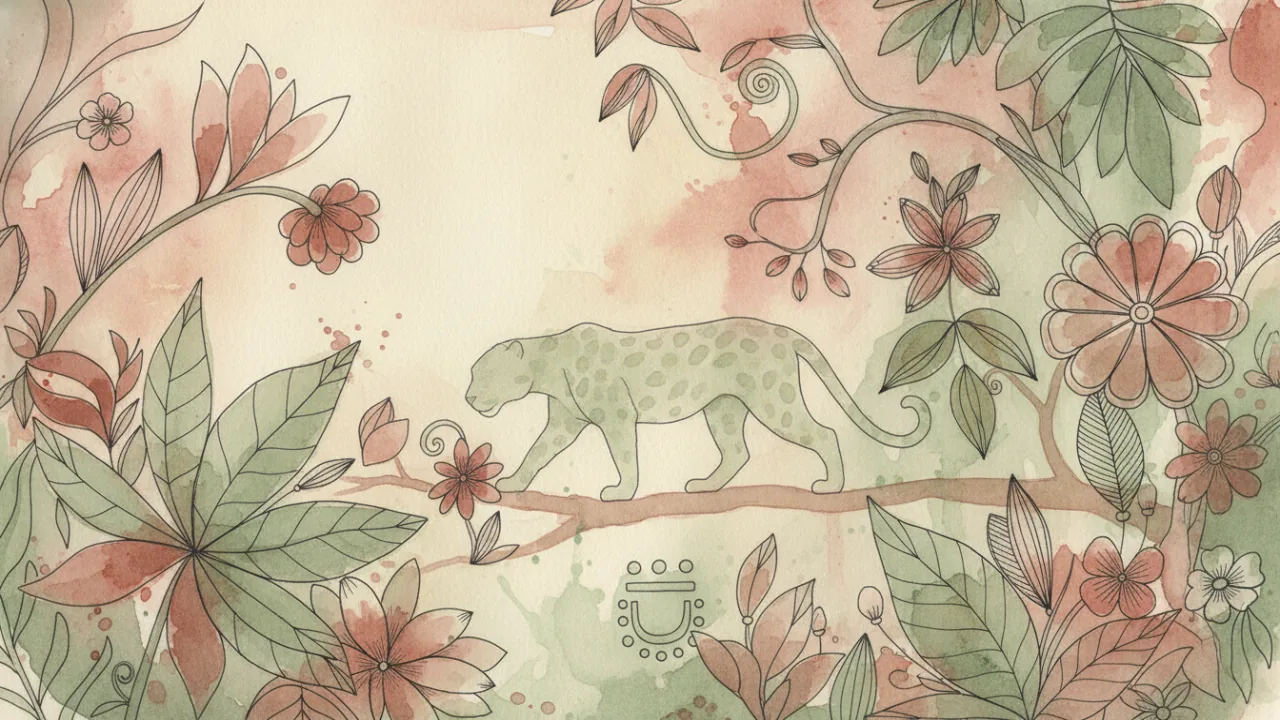
Watercolor scene evoking the energy of the Maya day sign Ix

Cosmology and origins

Ix is the jaguar, and in Maya cosmology the jaguar is not a metaphor — it is a category of being. The classic-period kings wore jaguar pelts and took jaguar names because the animal was understood to move between worlds: the daylight forest, the night forest, and the layered underworld of caves and underground rivers. The nawal Ix is the residue of that older idea, the day-name carrying what the pelt used to carry on a king's shoulders.

The animal lives in the ceiba — the great green-trunked tree that the Maya consider the axis of the world, with roots reaching down into Xibalba and branches holding up the sky. Ix is what walks that axis quietly. In the codices its glyph shows a jaguar's spotted ear; in the Popol Vuh and the highland prayer cycles, jaguar-priests are the ones who keep the calendar and read the days. The sign carries that lineage of trained, secret knowledge.

There is also a feminine register here that English flattens. Ix in many Mayan languages is a female honorific — the syllable that begins women's names — and the day-energy carries a maternal, earth-bound quality alongside the predator's. The jaguar is read as both lord and lady of the forest, fierce and protective at once.

As a birth-sign

People born on an Ix day tend to live with a private interior the rest of us only get postcards from. They are watchful before they are talkative, and the watchfulness is rarely cold — it is more like the way a jaguar watches: relaxed, wholly present, taking in detail without needing to announce that it has. They often say less than they know, not from secrecy as a tactic but because language reduces what they have actually perceived.

There is usually a pull toward the esoteric edge of whatever discipline they enter. An Ix doctor reads about ritual healing in their off-hours; an Ix engineer keeps a dream journal; an Ix accountant is the one who quietly holds the company's emotional weather. The nawal does not turn its bearers into mystics by trade, but it does install a second channel that runs underneath whatever the day-job is.

Loyalty in this sign is real but selective. Ix people tend to keep a small inner circle and protect it ferociously. They forgive a great deal in private and very little in public; betray their trust and you will probably never know exactly when the door closed, only that it has.

Day-energy in practice

An Ix day in the calendar feels different from the days around it — quieter, denser, more inward. Daykeepers in Guatemala traditionally treat Ix as a day for mountain altars and for matters that touch the land itself: thanksgiving for a harvest, asking permission of a place before building, prayers for a sick animal. The energy is closer to the ground than the sky.

Practically, the day rewards small, deliberate acts done with attention. Re-reading a difficult chapter; a long walk taken alone; the kind of conversation that happens in a kitchen at night and is never quite repeated. Things rushed on Ix tend to lose their charge; things done slowly tend to keep it.

It is not a day for launches, announcements, or any kind of public bid for attention. The nawal does not punish those, exactly, but it withdraws its support from them. An Ix day used well leaves a person more themselves at the end than they were at the beginning, with no particular evidence to show anyone else.

Practices and tradecraft

The tradecraft of Ix is the tradecraft of the threshold. Lighting a candle before beginning work; sitting for a few minutes in silence at the doorway of a new room; asking an old place permission before changing it. None of these are dramatic, and that is the point — Ix practices are designed to be invisible to anyone not looking for them.

Highland Maya ajq'ijab' (daykeepers) often treat Ix as a day for visiting altars in caves and at the base of trees, leaving small offerings of copal, candles, and seeds. The form matters less than the orientation: an acknowledgement that the world is layered, and that the layers respond to being addressed with respect. A modern Ix practitioner can do the same with a houseplant, a doorway, or the corner of a room kept as a small altar.

Dreamwork lives here too. Keeping a notebook by the bed, paying attention to the dreams that recur, treating sleep as a place where work continues — all of this is native Ix territory. So is study that goes deeper than the surface a discipline shows the public: the original sources, the forgotten teacher, the version before the version everyone cites.

Tradeoffs and shadow side

Ix's shadow is the same as its gift, turned inward too far. The privacy that protects an inner life can curdle into isolation. The discernment that lets an Ix read a room can become a habit of staying outside it, watching from the canopy, never quite stepping into the clearing. Loved ones of Ix people sometimes describe a feeling of never fully reaching them — a polite glass wall they cannot find the seam of.

There is also a hoarding tendency around knowledge. Because the nawal honors the unspoken, Ix can default to keeping insight to itself even when sharing it would help. The shadow form is the practitioner who collects esoteric understanding and never quite teaches it, the friend who knows what's wrong with the relationship but won't say.

Power that does not announce itself is also power that can be used unseen. An Ix who leans into the secret-keeping without examining it can manipulate quietly — never lying outright, just letting people stay in the wrong picture because correcting them would cost privacy. The work of the nawal is learning when concealment is reverence and when it is just convenient.

Trecena rhythms

A trecena that opens with Ix sets a thirteen-day arc that is initiatory in the old sense — meaning it begins a thread of inward training rather than a campaign of outward action. Whatever you start in the first day or two of an Ix trecena will tend to deepen rather than broaden over the stretch. A practice begun here roots; a project begun here gets quieter and more interesting.

By the middle days the energy turns specifically inward. Old Maya teachers speak of the trecena's middle as its night — the days when the underlying lesson surfaces. In an Ix trecena that lesson usually has to do with concealment and revelation: what to keep, what to share, who has earned which. Decisions made in this middle stretch about who gets access to what tend to hold for a long time.

The closing days of an Ix trecena often bring a private clarity rather than a public outcome. You will likely end the thirteen days knowing something you did not know on day one, without necessarily being able to explain it to anyone. That is the nawal working as designed. Trust the deepening, even when there is nothing to point at.

Frequently asked questions

  • What does the Maya day sign Ix mean?

    Ix means jaguar — the 14th of 20 Maya day signs. It is the nawal of shamans, sacred earth altars, and feminine magic. Direction North, color white. K'iche' day-keepers call it I'x.

  • Is Ix a male or female sign?

    Ix carries strong feminine energy. In many Mayan languages Ix is the female honorific that begins women's names (as in Ix Chel, the moon goddess). The jaguar is read as both lord and lady of the forest at once.

  • Why is the jaguar a shaman's animal?

    The jaguar moves between worlds — daylight forest, night forest, and Xibalba. The Maya sun god K'inich Ajaw became the Jaguar God of the Underworld each night. Shamans and kings wore jaguar pelts to claim that crossing power.

  • What should I do on an Ix day?

    Treat Ix as a quiet, ceremonial day. Day-keepers visit altars in caves or at tree-roots, leaving copal, candles, and seeds. Good for meditation, dreamwork, and asking permission of a place. Avoid loud public action.