Day 10 of 20 in the tzolkin

Ok

dog / loyalty

Loyalty without leash. The chosen tribe.

  • loyalty
  • companionship
  • ethics
  • presence

Ok is the dog — and in Maya thought the dog is not a sentimental pet but a guide between worlds, the keeper of the threshold, the one who knows the way back. Ethics and devotion are both at home in this nawal.

People born under Ok tend to organize their lives around a small number of relationships they take very seriously. They are the friends who actually show up — to the move, to the hospital, to the hard conversation. They have an instinct for fairness that can read as stubborn from the outside; really it's a refusal to let people they love get cheated.

On an Ok day, repair things between people. Apologize where one is owed. Reach out to the friend you've been meaning to. The nawal favors presence over performance, and remembers what was said.

A trecena opened by Ok is relational. It deepens whatever bonds you choose to give time to.
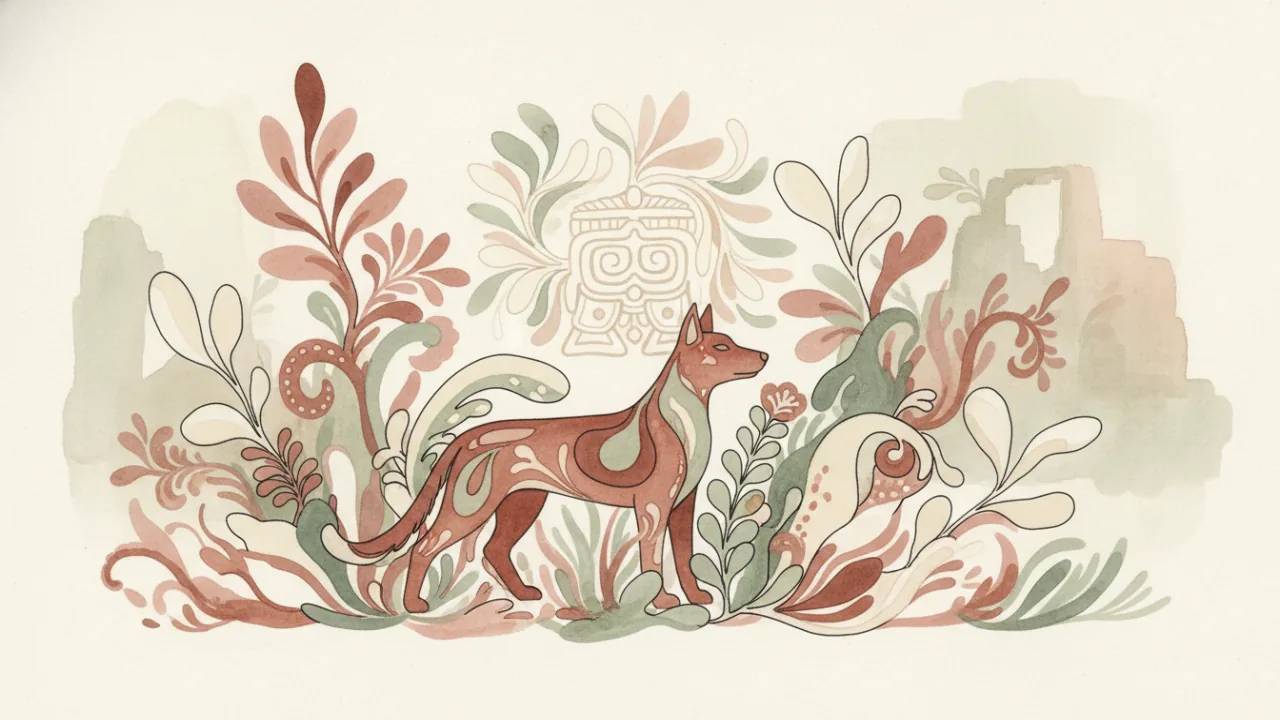
Watercolor scene evoking the energy of the Maya day sign Ok

Cosmology and origins

Ok is the tenth nawal of the tzolkin and the day-sign whose face is the dog. In the older Maya cosmology the dog is a psychopomp — the animal that travels between this world and the next, who knows where the openings are between caves and stars, who waits at the threshold of the underworld and pads back across without losing the path. Long before the Spanish brought new theologies, the dog was already a serious figure: it walked beside the dead in the painted books, it was carved at the mouths of tombs, it sat next to the hearth as a small living hinge between the family and everything that lay outside.

The Classic-period scribes drew Ok with a canine muzzle and an ear cocked forward, sometimes carrying a torch in its teeth — the light that goes ahead of the soul on a dark road. In several highland Maya communities the day is still called by names that translate to dog or guide, and the daykeepers who count the tzolkin describe Ok days as right for matters of friendship, justice between people, and the kind of devotional work that is more about showing up than about ceremony.

What is striking about Ok across centuries is how steady the meaning has stayed. Where other nawals shift register depending on region, Ok consistently carries loyalty, threshold-crossing, and ethical companionship. It is one of the day-signs that least needed to be reinterpreted to survive into the present — the dog at the door is still the dog at the door.

As a birth-sign

People born on an Ok day tend to organize their lives around a small handful of relationships they take with unusual seriousness. They are not necessarily the friend with the largest social map; they are the friend who, twenty years in, is still calling on the right anniversaries, still remembering which surgery is coming up, still treating the friendship as something that requires tending. The nawal teaches that loyalty is not a feeling you have once but a practice you keep refreshing.

There is a fairness instinct here that can register from the outside as stubbornness. An Ok person watches how the people they love are being treated, and if something is off — if a contract is unfair, if a story is being twisted, if a friend is being blamed for something that wasn't theirs — they will quietly refuse to let it slide, even when the easier social path is to nod. This is the dog that growls at a wrong shape in the doorway. It is uncomfortable to live with sometimes; it is also one of the deepest gifts the nawal offers the people inside its circle.

Underneath the loyalty there is often a tender, almost guarded inner life. Ok-born people frequently feel things at high resolution but hold them close, releasing them only to a few. Their devotion is not loud, and they tend to distrust people who perform devotion in public. The work of the sign across a lifetime is learning to receive care as fluently as they give it.

Day-energy in practice

When Ok arrives in the count it tunes the day toward the relational. Conversations that have been postponed find a window. Repair work between people that felt impossible last week feels merely uncomfortable today. The nawal favors presence over performance — what matters on an Ok day is being there, returning the call, walking back into a room you walked out of and sitting down again.

Practical things shift in this energy too. Ok days are good for renewing agreements that have started to feel thin: revisiting a partnership, restating what a friendship is for, checking in with a long-running collaborator about whether the work is still serving both of you. The dog-nawal will not let people drift apart politely — it asks for the small acts of contact that keep a bond from becoming a memory.

On the inner side, Ok days reward an ethical recalibration. They are good days to ask whose interest you have been quietly serving and whose you have been quietly sidelining. The nawal does not call this a moral audit; it calls it a sniff at the threshold. Either way, what gets noticed today tends to come back later asking to be addressed.

Practices and tradecraft

The traditional ways of working with Ok are unfussy and almost domestic. Daykeepers light a candle and name out loud the people who have walked with them — the living and the dead — thanking each one specifically rather than in a single bundled prayer. The nawal responds to particularity. Generic gratitude does not move it; remembering that this person stayed in 2017 when the rest of the room left does.

A simple at-home practice on Ok days is the threshold offering: a small bowl of water, a piece of bread, a flower at the doorway, set down with the intention of honoring whoever crosses in and out. Some lineages add a quiet recitation of the names of friends who are unwell or far away. None of this is theatrical. The nawal prefers the kept candle to the staged one.

For people who carry Ok as their birth-sign, the steadiest tradecraft is relational hygiene: a regular rhythm of voice calls instead of texts, a habit of writing one real letter a month, a discipline of not letting a misunderstanding survive past sundown. Ok teaches that devotion is built out of small, returnable acts — and that those acts, repeated, eventually become the spine of a life.

Tradeoffs and shadow side

Every nawal has a shadow, and Ok's is the shape of its strength turned inward. Loyalty unmoored from discernment becomes attachment to people or institutions that have stopped earning it. The dog who guards the wrong gate is still a dog doing its job, but the job no longer serves anyone. Ok-born people sometimes stay too long — in jobs, in friendships, in family arrangements — because leaving feels like betrayal even when the actual betrayal is the staying.

The fairness instinct, pushed past its useful range, can harden into a grudge held on principle. Ok is good at remembering, and that memory can curdle if it is not occasionally let go. Some lineages name this shadow as the dog at the wrong door — protecting something that has already moved on, growling at people who are no longer the threat.

There is also a quieter shadow in the difficulty of receiving. People with this nawal often give devotion they would refuse to accept in return, treating their own needs as smaller than other people's. Working the shadow means letting the people who love you actually love you back — letting a friend show up for your hospital visit, your move, your hard conversation, without immediately leveling the score.

Trecena rhythms

A trecena that opens with Ok carries the relational signature of the nawal across thirteen days. The early days set the question — who is in the chosen tribe, what is the bond actually for, where has loyalty been given without being chosen. The middle days tend to be where the repair work happens: apologies offered, accounts cleared, contact restored with people whose absence had become a quiet ache.

Daykeepers describe Ok trecenas as steady rather than spectacular. They do not produce dramatic external events; they produce the quieter rearrangement of a life around the relationships that are actually carrying it. Several days into the count it is common for an Ok-trecena person to notice that they are returning calls they had been avoiding and stepping back from contacts that had been draining them. The nawal sorts.

By the closing days the trecena has usually deepened the bonds it found worth deepening and gently dissolved the ones it did not. It rarely dramatizes the dissolutions; the dog is not a creature of scenes. What remains at the end of an Ok trecena is a smaller, truer circle and a clearer sense of who you would walk through the threshold beside.

Frequently asked questions

  • What does the Maya day sign Ok mean?

    Ok (K'iche': Tz'i') is the 10th nawal of the tzolkin, symbolized by the dog. It governs loyalty, ethical companionship, and justice between people. Day-keepers also call it the nawal of law.

  • What direction and color belong to Ok?

    Ok sits in the North, the white direction of the Maya cosmos — the realm of refinement, ancestors, and cold clarity. It shares North · White with Ik', Kimi, Ix, and Etz'nab'.

  • Does Ok / Tz'i' have a shadow side?

    Yes. Highland K'iche' tradition describes Tz'i' as the nawal that, when unbalanced, drifts toward instinctual excess — drunkenness, lust, infidelity. The same dog that guards the threshold can chase any scent.

  • Why is the dog a soul-guide in Maya thought?

    Yucatec Maya believed dogs led souls across the dark waters of Xibalba. Dogs were buried with the dead and carved at tomb mouths. In the Dresden Codex the dog also carries a torch — the light that goes ahead on a dark road.