Day 3 of 20 in the tzolkin

Ak'b'al

night / darkness

Inside the cave. Where dreams are still real.

  • night
  • dream
  • interiority
  • mystery

Ak'b'al is the dark before dawn — the night-half of the day, the inside of the house, the chamber underneath the temple. It is the realm of dream, of secrets the daytime is too noisy to hear, and of the slow patient work of the unconscious turning material over.

As a birth-sign, Ak'b'al gives a long inward stride. People with this nawal often feel more themselves at night and find that their best thinking happens in private, on a walk, in the bath, before anyone else is up. They tend to keep their own counsel and reveal information in layers.

On an Ak'b'al day, the recommended movement is downward and inward. Journals open. Strange dreams stick. Decisions that demanded full sun yesterday now want a quieter room and a candle.

A trecena that begins in Ak'b'al is one for foundations — the unseen structural work that won't be visible for weeks. Don't mistake the silence for stagnation.
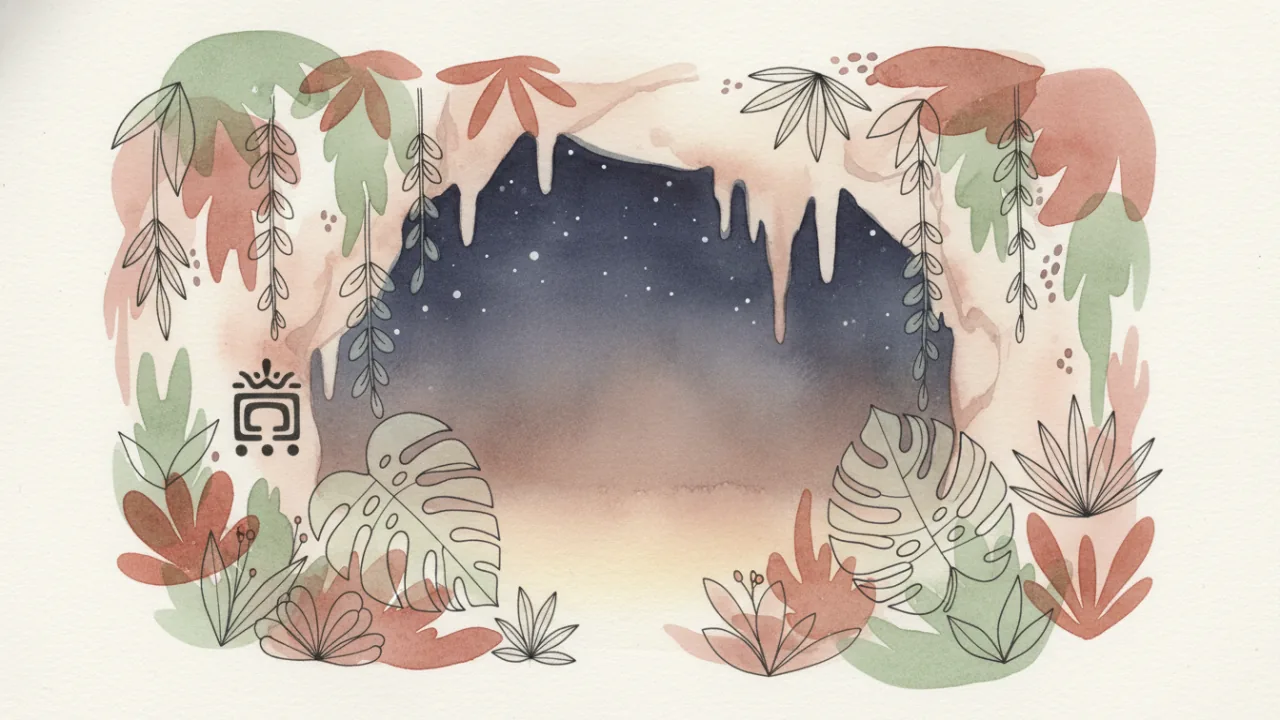
Watercolor scene evoking the energy of the Maya day sign Ak'b'al

Cosmology and origins

Ak'b'al is the third nawal in the tzolkin count, and within Maya cosmology it occupies one of the most architecturally precise positions: the cave, the womb of the mountain, the inside of the earthenware bowl that holds the night. In the older highland Q'eqchi' and K'iche' traditions, Ak'b'al names not just darkness but a specific kind of dark — the lined, contained, protective black that exists inside enclosed spaces. The classical glyph shows the half-closed eye of a jaguar at rest, an image the day-keepers read as the sleep-state where vision turns inward and the spirit travels on its own errands.

The nawal is woven through the surviving codices and the colonial-era K'iche' source we now call the Popol Vuh, where the underworld of Xibalba is reached through caves and where the Hero Twins endure trials in chambers that test them precisely because their senses must work in the dark. Ak'b'al is the day on which a community traditionally honors that lineage — not the macabre version Western readers sometimes import, but the ancestral truth that the dark is also where seeds open and where the unconscious does its real labor.

An ajq'ij — a Maya day-keeper — will tell you that Ak'b'al was set into the count to remind people that not everything sacred is bright. The day belongs to dreamers, to midwives, to those who tend the small hours. Its older offerings include white candles at thresholds, copal at the mouths of caves, and quiet thanks given to the houses and the bodies that have sheltered us through nights we did not understand at the time.

Born under Ak'b'al

People born on an Ak'b'al day tend to carry an unusual amount of inner architecture. They have rooms inside themselves, and they live in them. From the outside this can look like reserve or shyness, but it is more accurately a settled comfort with their own interior: they have furnished it, they know where things are, and they are not in any rush to give the tour. They often arrive at insight by sitting with a question rather than attacking it, and the conclusions they reach tend to be unusually stable because they have been weighed in the dark before being shown the light.

There is a strong dream-life in this nawal. Many Ak'b'al people remember their dreams in detail, find that ideas resolve overnight, and notice that they receive useful information in the half-hour before sleep and the half-hour after waking. The tradition takes this seriously: dreams are considered a legitimate channel of guidance, and an Ak'b'al person learning their own count is often encouraged to keep a dream notebook for at least one trecena before drawing conclusions about what they're being shown.

The social signature of an Ak'b'al birth is loyalty in private and discretion in public. They will not tell your secret. They are also slow to give their own — sometimes to the frustration of partners and friends, who can mistake the pacing for distance. The right relationships for Ak'b'al people are ones with patience built in; they open in layers, the way an old house reveals itself room by room, and what is found at the end of that opening is usually worth the wait.

Day-energy in practice

When Ak'b'al governs a day, the recommended motion is downward and inward — not in the depressive sense, but in the architectural one. The day favors going into rooms rather than throwing windows open. It is excellent for review, for editing, for the kind of meeting that needs honesty more than enthusiasm, and for any work whose quality depends on a steady inner gaze rather than outward performance. Plans laid on Ak'b'al days tend to age well because they were drawn in a quiet hand.

The body tends to ask for slower fuel on this day: warm food, water, less stimulation, an earlier bedtime. Many practitioners notice that caffeine and bright screens feel particularly out of register, while a candle, a long bath, or twenty minutes of doing absolutely nothing feel disproportionately restorative. The nawal does not insist on austerity — it simply rewards the choices that line up with its grain.

It is also a day on which other people's secrets sometimes arrive on your doorstep. Friends call to confess. Conversations go deeper than the agenda. The right response is the one this nawal has always asked for: listen, don't broadcast, and remember that confidences shared on an Ak'b'al day are still confidences a year later. Discretion is not a personality trait here; it is a kind of sacred housekeeping.

Practices and tradecraft

Traditional practice on Ak'b'al days is built around enclosed, protected spaces. The household altar is tended; thresholds are blessed; the home itself is treated as a living being that has carried you through more than you remember. Day-keepers light a single white candle at dusk and let it burn down without rushing it, often using that hour to write down dreams, name fears that have been circling, or speak quietly to ancestors whose names the family still knows.

Copal is the classical incense for this nawal — its resin smoke is said to be particularly congenial to the dream-state and to the work of softening hardened thoughts. Where copal is unavailable, beeswax candles, white flowers, and a small bowl of clean water on the altar carry the same intent. The point is not the specific material but the gesture: making the inside of your house a place where the unseen feels welcome to visit.

For people working actively with their nawal, Ak'b'al rewards a few quiet disciplines: a dream notebook kept at the bedside, a short evening review of the day's interior weather, and the careful tending of the few relationships in which you can be fully honest. Tradecraft here is not flashy. It is the slow accumulation of inner ground, and the people who practice it well tend, over years, to become the ones their communities go to when something needs to be heard rather than fixed.

Tradeoffs and shadow

Every nawal has its shadow, and Ak'b'al's is the cave that becomes a hiding place rather than a workshop. The same depth that lets an Ak'b'al person hold a confidence and incubate a slow truth can, untended, turn into withdrawal — staying inside long after the work is done, mistaking isolation for self-care, or letting introspection harden into rumination. The interior is meant to be lived in, not barricaded.

Secrecy is the other classic shadow. Discretion is a gift, but it can curdle into omission: the partner who wasn't told, the colleague kept in the dark, the family pattern carried in silence because nobody felt safe enough to name it. Ak'b'al people sometimes keep things to themselves not out of malice but out of an old instinct that information is safer unspoken. The work is learning the difference between a confidence honorably held and a truth that needs daylight to heal.

There can also be a tendency to over-trust the dream-channel — to read every nightmare as prophecy, every coincidence as message. The tradition is clear that dreams are one input among several; they speak alongside the body, the calendar, the council of trusted elders, and the plain evidence of waking life. An Ak'b'al person grows by learning to weigh the dark voices against the day-lit ones, and to come back into the room when the room needs them.

Trecena rhythms

When a trecena opens with Ak'b'al — the thirteen-day stretch that begins on 1 Ak'b'al — the entire arc tilts toward foundation work. These are the weeks in which buildings get drawn but not yet poured, in which relationships have their long talks before any visible change, in which the structural decisions are made that will look obvious in hindsight and almost invisible at the time. People who pay attention to the count often notice that big quiet pivots in their lives turn out, on later inspection, to have been seeded inside an Ak'b'al trecena.

The middle days of the trecena tend to feel slower than they are. Progress is happening — it just isn't postable. The tradition treats this as a feature: the count is reminding you that the most durable change usually starts where no one is looking. Patience during this stretch is not passivity. It is the discipline of staying with a process whose results have not yet broken the surface.

By the time the trecena closes, something has usually settled. A decision that felt impossibly tangled at the start has quietly arranged itself; a relationship has found a new resting position; a piece of work has acquired a backbone you did not know you were giving it. Ak'b'al trecenas reward the people who trust the dark for the length of time the dark needs to do its work — and they tend to send those people forward into the next thirteen days more rooted than they were before.

Frequently asked questions

  • What does Ak'b'al mean in the Maya tzolk'in?

    Ak'b'al (K'iche': Aq'ab'al) means night, darkness, or dawn. It is the third of twenty day signs and represents the cave, the dream-state, and the threshold between night and day.

  • What direction and color is Ak'b'al?

    Ak'b'al belongs to the West, associated with the color blue and the element water. The West governs transformation, sunset, and the receptive death-rebirth axis of the Maya cosmos.

  • What deity rules Ak'b'al?

    The Jaguar God of the Underworld — the Night Sun who travels through Xibalba while the day sun rests. He patrons the number 7 and embodies the nocturnal jaguar that the day sign's glyph depicts.

  • What are people born on Ak'b'al like?

    They are introspective, dream-attuned, loyal in private, and discreet in public. They process slowly, trust intuition, and often become quiet counselors others go to when something needs hearing rather than fixing.